How to Stop Procrastinating: Start Small and Make Progress
The hardest part of getting something done is simply the act of getting started. What if overcoming procrastination doesn't start with finding more motivation, but rather with starting small? Learn more about how to stop procrastinating and how starting small can help you make progress.
The longer you wait to feel ready, the longer you end up waiting. When a task feels too big to start, make the first step smaller. A task doesn’t have to become easier for you to start; rather, it just has to feel small enough to begin.
For most people, the hardest part of getting something completed is often simply getting something started.
You know what needs to be done. The workout is planned, the diet plan is made, the homework assignment is waiting, an email needs to be sent, a project needs to get done, sitting untouched for days. Somehow, regardless of all of this, and knowing that it needs to be done, starting the task feels harder than the task itself.
You tell yourself that you will do it later.
Later becomes tomorrow.
What if overcoming procrastination doesn’t start with finding more motivation, but rather starts by making the first step smaller.
Meaning of Procrastination - Why Do We Procrastinate?
Essentially, procrastination is the act of putting off or delaying tasks that need to be done to the very last minute or past their deadline. These tasks often feel boring, overwhelming, unpleasant, difficult, uncomfortable, or stressful. Everyone puts things off, but those who procrastinate often look for ways to avoid difficult tasks and actively find ways to look for distractions. Even though those who procrastinate may not realize it, their mind is actively looking for ways to avoid the task. In a sense, it is a coping behavior.
Playing video games or doomscrolling on social media when a work or school project is due the next day is an example of someone procrastinating.
Procrastination isn’t simply a matter of laziness or poor time management. A lazy person does nothing and feels fine and content that they are doing nothing. A procrastinator wants to do the work, but struggles to begin that work and feels guilty about it.
Procrastination Cycle
The procrastination cycle is a loop caused by a trigger that leads toward anxiety and task avoidance. It brings short-term relief, but that trigger leads to long-term consequences that form guilt and even worse anxiety.
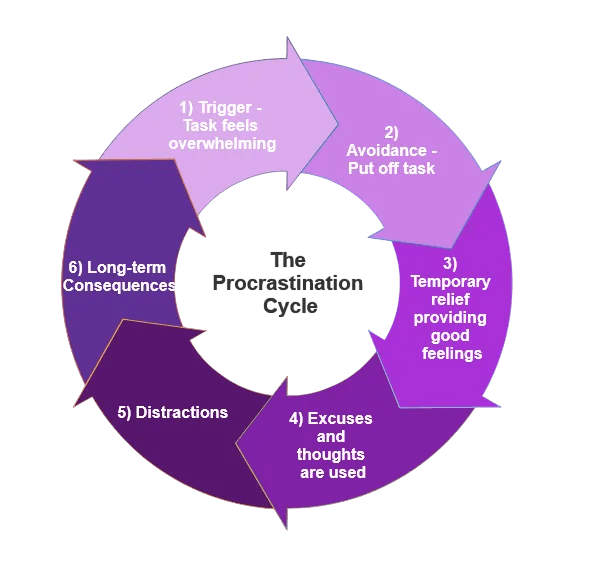
The cycle often starts with the trigger, where the task begins to feel overwhelming, leading to anxiety or fear of failing. This leads to avoidance, where the task is often put off to the side to do tasks that are considered more fun and easier, activities that essentially help to forget about the task. As a result of that, you feel a temporary short-term feeling of relief that provides a good feeling, a reward. That temporary feeling of relief leads to excuses such as: “I still have a lot of time to finish my presentation”. Distractions come next, using examples such as video games, sleep, the internet, friends, or even food as ways to avoid the task. In the end, it is postponement. Long-term consequences are built up as the deadline gets closer, the task feels even harder, anxiety builds up, and it makes the whole situation much worse than when it began.
Procrastination can become self-reinforcing. Avoiding the task may provide temporary relief, but the unfinished task that was put off doesn’t simply disappear. As deadlines approach or responsibilities build up and accumulate, everything just becomes more difficult. Breaking the cycle doesn’t always require finishing the task. Sometimes, you just need to find a way to interrupt the process by starting.
How to Quit Procrastinating
Procrastination is all in the brain. Your brain encounters a task that triggers a negative feeling, and your brain is designed to protect you, helping you to avoid that threat for that negative feeling. Doomscrolling on your phone, reorganizing your bedroom, starting a TV show episode, or a YouTube video aren’t all random distractions, but rather your brain trying to repair or cope with short-term mood distractions. It may feel good in the moment with that temporary relief, but it just builds bad habits and reinforces that behavior of avoidance. Next time you face a similar task, your brain will simply default to the same escape route, a never-ending loop of the procrastination cycle.
The trick to helping you quit procrastinating is to determine your pattern to what is causing you to procrastinate and build a system to help avoid it in the future. You want to replace those bad habits with good ones.
7 Ways to Overcome Procrastination
- Figure out what you are actually trying to avoid
It is important and key to identify the obstacle in front of you to help you change your approach.
Instead of asking yourself:
“Why am I so lazy?”
Ask yourself:
“What is making this task so difficult to start?”
Perhaps you need to explore some of these factors:
- The task is too large for you to handle
- You have no idea where to begin
- You are worried that you are going to do the task badly (eg. bad grade)
- You may feel the task is boring
- The deadline feels like it is far away and that you have plenty of time, making it hard for you to start
- The task feels too complicated with too many steps
- Something else feels easier or more rewarding to do right now
- Make that first step smaller
When it comes to fixing a bad habit, starting small is always better.
In school, when you are assigned a task to create a presentation for the teacher and the other students, it would feel a lot better to break it down into smaller steps and perhaps plan your approach beforehand.
For example, on day one, you could hypothetically break it down:
Open PowerPoint
↓
Create title slide
↓
Create three section headings
↓
Draft slide one/introduction
You can also look at it as having the task of cleaning your bedroom. It may seem boring, but it must be done. Instead of putting it off, set a smaller goal that is easy to achieve and gradually get to a point where starting the task is easy to achieve. Putting away five items in your bedroom can serve as a simple, easy task to help you get started. Once you get started, the rest feels easier. You can either choose to continue or plan out how you can break down that one big task into smaller ones.
Don’t shrink the goal. Rather, shrink the action required to begin moving toward it.
- Try the five-minute rule
The premise of this rule/exercise is very simple. If the task feels small enough to complete, do it now. If a task feels too large to complete, shrink it to what you would consider the “five-minute version” of the thing you have been putting off and avoiding. If that task takes five minutes to do, it is easy enough to get it done now.
If you are procrastinating on… | Start with… |
Exercising | Go on a 5-minute walk |
Writing | Write 50 words |
Studying | Review one page of study material |
Reading | Read 5 pages |
Job searching | Review one job posting |
Starting a project/assignment | Write down the first three steps |
Answering emails | Respond to one email message/response |
They all may seem small, but there is great importance in just getting started. You don’t have to continue the task after getting started with the small task and completing the “five-minute rule”. If you do, that is great, but you don’t have to continue the task right that very second. You have already taken the first step to show yourself that you have still taken action. Taking action is the first step toward achieving your goal.
- Decide when you will get started
Most people start off their goals to start their task by saying: “I will get started on this presentation this week.” This sounds like a plan, but the truth is, it isn’t. You are disguising that hope of beginning the task with a broad plan you may or may not fulfill. There is no when or where, but rather the trigger that you are looking for.
Instead of telling yourself:
“I will get started on this presentation tonight.”
Tell yourself:
“At 7:00 pm, after dinner, I will sit at my desk and write down the first three steps for my presentation”
Introduce a structure that you can follow with a “when” implementation.
“When [situation happens], then I will [specific behavior/action]:
- “At 6:00 pm, before dinner, I will put on my running shoes and go for a walk outside for 10 minutes.”
- “After dinner, I will review one page of my study notes”
- “After I drink my morning coffee, I will write 500 words for my essay”
- The Pomodoro Technique
The Pomodoro Technique (PT) is a time management method that splits work into intervals that are focused and include brief breaks. This time management method breaks down work into 25-minute focused intervals separated by short breaks. This single 25-minute block is called “pomodoro”. The intention of this technique is to work on a single task of your choice until that 25-minute timer ends, avoiding all distractions. When that timer ends, you are expected to take a short 5-minute break. After doing this for four rounds, take a longer break between 15 and 30 minutes.
The purpose of this technique is to help fight procrastination. You aren’t agreeing to finish the entire task all at once, but rather agreeing to 25 minutes, one focused block. There is an emotional weight that lifts when you agree to focus fully until that 25-minute timer goes off rather than having to face finishing an entire project to meet a deadline.
Why The Pomodoro Technique Works
The Pomodoro Technique works because it helps to reduce burnout, where short work blocks help prevent mental fatigue. It improves your focus by training your brain for short, uninterrupted blocks that limit daily distractions. It makes starting a big task feel easier by committing to just 25 minutes. Most people feel fatigue when trying to complete a task up to a certain point, and everyone has their own limits in terms of their willpower. These scheduled breaks designed by The Pomodoro Technique keep your cognitive abilities from burning out.
- Stop waiting for the perfect moment
The message behind this is to understand that you should stop waiting for the right moment, the perfect moment.
Most often, people tell themselves:
“I’ll start on Monday.”
“I’ll do it when I have more energy.”
“I’ll do it after I eat dinner.”
“I’ll start next month.”
People find ways to make excuses, ways to delay and avoid the task in front of them. The problem is that these ideal starting conditions may never arrive; you may delay your task by saying “I’ll start going to the gym on Monday”, but that condition may never arrive.
You don’t need the perfect time to start; rather, you need a starting point that works with the time that you have. Stop delaying the inevitable and waiting for the perfect moment, because there is no such thing as the perfect moment.
Learn to be more consistent, as consistency proves why small actions beat motivation.
- Track your ability to show up, not just finish
Having the ability to track when you show up is important. By tracking what days you go to the gym every day, week, and/or month, you can answer the question, “Did I show up?”
Let’s say, for example, that you are looking to finish writing your essay for school; instead of tracking when you “finished the essay”, you should instead track a small task that would eventually lead toward that end goal of finishing your essay. Perhaps instead you can track the number of words you could write that would eventually lead you toward finishing the essay.
For example:
End goal: | 3,500 words |
Track: | 200 words per day |
M T W T F S S
■ ■ ■ □ ■ ■ ■
■ ■ □ ■ ■ ■ ■
■ ■ ■ ■ ■ □ ■
This tracker shows you the days you showed up and helps you answer the question, “Did I show up?” Rather than asking yourself, “Have I finished yet?”, you are fulfilling something that is achievable and reasonable within your ability, and doing something that would eventually lead you toward that final goal. With this example, you can see that this person showed up every day in the week except for one day, showing a sample size of 18/21, which is approximately 86%. This data shows that you showed up 86% of the time. Even if you miss days, that is perfectly fine, as long as you show up and do something that is reasonable within your grounds to reach that goal; that is what matters. As long as you reach the finish line when the time comes.
If you planned to study for an hour but only study for 20 minutes, that is still 20 minutes of study time. If you plan to work out at least five times in a week but only go three times in one week, that is still three days of you showing up. Doing less than what you planned is still better than doing nothing. Progress does not have to be perfect to count.
Progress over perfection.
How to Stop Being Lazy
Laziness and procrastination can be considered similar in some ways because they both mean that you lack motivation. We become lazy because we are tasked to do something that were reluctant to do because of the effort involved, something that you don’t want to do because it is boring or makes you feel uncomfortable. The main difference between laziness and procrastination is the fact that with procrastination, you feel guilty and bad about not completing the task. A procrastinator aims and intends to complete the task eventually, although it comes with a cost. A reminder, as already explained above in a previous section: “A lazy person does nothing and feels fine and content that they are doing nothing. A procrastinator wants to do the work, but struggles to begin that work and feels guilty about it.” It is important to understand the difference between the two.
Ways to Avoid Procrastination
In order to stop yourself from reaching that point and avoid procrastination, you need to manage your emotions and start small. Break down those large tasks/goals into steps that are smaller and more realistic for you to manage. You know yourself better than anyone, so only you know what is manageable for you.
Create a framework for yourself that is easy to follow, a guide that will help you move forward:
- Start Small - “What’s the smallest useful action to help me obtain my end goal”
↓
- Make it specific - figure out exactly one small thing you can do to help you reach your goal
↓
- Make it easy and manageable for you to get started - remove the friction
↓
- Do the task that you set - don’t wait to do your task, don’t wait for perfect motivation
↓
- Track your progress - make the progress you are achieving visible
↓
- Repeat the process - come back tomorrow and prove to yourself that you can show up
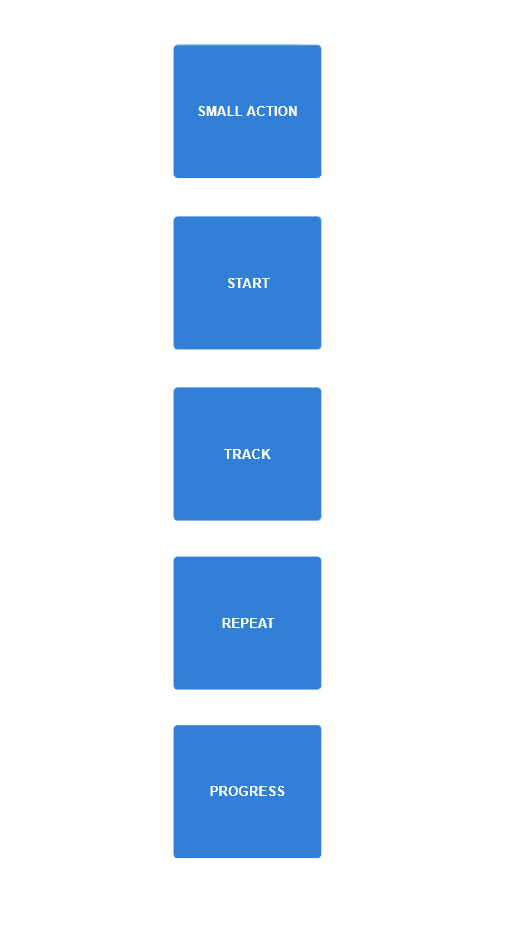
Ultimately, it is important to break down your tasks into something smaller and manageable, adjust your mindset, and remove any distractions. Forgive yourself for past failures in procrastinating as that guilt would only build up and make things worse, focus on completing the task rather than being perfect, and never forget to give yourself time to breathe, make mistakes, and reward yourself.
Small Actions Add Up
Small actions may seem insignificant when viewed individually, but when put together, it is truly meaningful. Whether you decide to study for five or ten minutes, read two or five pages of a book, or even spend ten minutes working on an assignment, there is value in showing up. These actions may not feel transformative, but the value isn’t only in what you do today, rather, it creates more opportunity for the future, and most importantly, the very next day.
Ultimately, procrastination has the evil purpose of making us only focus on everything that needs to be done. We are all human, and it is inevitable that we have a lot going on in our lives, no matter what position we are in. That unfinished assignment that you are putting off, reading a book that you need to get done, going to the gym, the messy room you still need to clean up, or that project that should have been started weeks ago - all of these things are examples of tasks that people tackle every day.
The truth is, you don’t have to finish everything right now; you just have to decide what happens next. Open the document and begin the assignment, reading one page of that book, putting on your shoes to take that first step in working out, cleaning one part of your room, or working on that project even for just five minutes, all of these small little tasks show that you are making progress and starting that journey toward getting to your end goal. Do these tasks, and do them again tomorrow.
This very moment, it may feel small, it may feel that these small actions aren’t transformative in the moment, but they give you progress and give you a place to start, because starting something can be just as hard as getting it done. You put yourself in a position where you have somewhere to begin.
When something feels too big to start, make the next step smaller, and give yourself a chance to breathe.