How to Use a Habit Tracker to Build Habits That Actually Stick
Sticking to a new habit isn’t easy and most fail to keep up with their habit in the first few weeks of starting one. Learn more about how to use a habit tracker and how to build habits that actually stick and stay with you in helping you reach your goals.
Sticking to a new habit isn’t easy, and if we are being honest, most fail to keep up with their habit in the first few weeks of starting one. Starting a new habit is easy; sticking to one, however, is where things get difficult.
We’ve all started a new habit, being fully convinced that this time, it’s finally going to stick. Sticking to a habit is where things get difficult. Within every habit you are trying to build comes motivation - determined that this time, things will be different - but a missed day can turn into two, motivation fades, and before long, you’re back where you started.
The truth is that good habits don’t fail because we don’t want them badly enough; rather, they fail when consistency becomes difficult. Every lasting habit normally starts the same way: with every small action, it is on you to choose to repeat tomorrow.
Starting a new habit usually isn’t the hard part.
Every morning you wake up, you decide that you are going to exercise, read a book before bed, go on daily walks, or, most importantly, stick to a daily routine. Most often, the first few days feel easy; you feel motivated, you make progress, and everything feels different.
Then, life happens and gives you a wake-up call.
You miss a day, then another, and before long, the habits you were determined to build have quietly disappeared.
This is the purpose of a habit tracker: it won’t magically make you more disciplined and solve all your problems, but if used more correctly, it can make something that may feel normally difficult feel easier, giving you a sense of confidence and motivation, the power to move forward and take that next step in your life.
Basketball legend Shaquille O’Neal has personally spoken about his core philosophy centered on building habits and success: “Excellence is not a singular act, but a habit. You are what you repeatedly do.”

The message behind this quote is inspiring. Excellence is rarely ever the result of a singular action; rather, it develops gradually through consistency, continuous improvement, and commitment. Whether you are a student, an athlete, a professional, or anyone for that matter, daily effort can and will eventually shape your long-term success. Real achievement comes from your small, daily actions, and ultimately, you shape your own identity, creating the standard based on your repeated behaviors for better or worse.
In this guide, we will look at how to use a habit tracker effectively and how you can use these habits to eventually shape your long-term success.
What is a Productivity App
The purpose of a productivity app is to help the user organize tasks, take notes, manage time, and collaborate with others more effectively.
Productivity apps have the purpose of saving your time or energy. It collects your tasks and thoughts, helping you make things easier. They help you get more done with less mental burden.
Types of productivity apps may include note-taking, project management, calendars and scheduling, task management, and habit trackers.
What is a Habit Tracker
In the most basic and simplest way of explaining it, a habit tracker is essentially a way for you to measure whether you did a habit. It is simply a system for recording whether you completed that habit or behavior in a structured format, specifically daily, weekly, and monthly.
The main purpose behind a habit tracker is to provide a clear visual record of consistency, allowing you to build new positive habits, break old ones that are negatively affecting your life, and create a system that keeps you accountable for your personal goals. Everyone wishes to lose weight or fix their bad sleep schedules; the purpose of habit trackers is to help you with those goals and provide a visual form of keeping track of them. It is very important to stay consistent with your goals, and that is something many people fail to do. Habit apps provide visual progress tracking and actionable insights into daily lifestyle patterns.
Core Problems Habit Trackers Solve
- Build habits
- Stay consistent
- Stop procrastination
- Staying accountable
- Reducing addiction
- Improving daily routines
- Improving mental health
- Reaching fitness goals
- Providing dopamine
Habit Tracker Examples
In short, a habit tracker is simply a system that will allow you to record and track whether you’ve completed a behavior/habit that you want to repeat.
Here are some examples:
Habit | Goal |
Walk | 10,000 steps per day / 20-minute walk |
Read | 30 minutes per day |
Study | 1 hour per day |
Water | Drink a glass of water in the morning |
Sleep | Get to bed by 11 pm / Sleep 8 hours |
Brushing Teeth | Brush and floss teeth twice a day |
Habit tracking can span several daily routines, wellness goals, and different productivity ideas. It can range from focusing on Health and Fitness, Mental Health, Productivity, and even Daily Care. It can be whatever you need or want to improve. Tracking habits can range from tracking many different things and in different time frames, allowing you to see how you have done daily, weekly, monthly, and even yearly. Habit goals can be simple or extreme, from tracking something as simple as drinking a glass of water in the morning to perhaps reaching a steps goal of 10,000. It is better to start small and be realistic; even a goal of going on a short walk can be a great start. Rather than starting big, it is better to start small.
Life is a marathon, not a sprint
Why Does Habit Tracking Work?
Habit tracking works as it leverages your core psyche. It provides you with the feeling of gratification and success through the visual progress tracker, offering tangible proof of consistency. Habit tracking provides dopamine, affecting your motivation, providing you with reward and pleasure, as well as focus. It rewards the brain with a tiny rush, making even the smallest of tasks feel victorious, motivating you to continue forward. There is momentum built through habit tracking and streak building, giving users a reason to “not break the chain”.
Most importantly, habit tracking is proven by the power of science. There has been a body of research that shows that habit tracking works through psychology. One of the most common findings in behavioral science is that self-monitoring can drive change for a person. Just by tracking a behavior, regardless of what it is - diet, study, exercise, mental health - it makes people want to continue forward. Every time you track your habit and check a box, you are giving your brain feedback, and that feedback is fuel to push you further so that you can grow. Each checkmark is a tiny little reward for the brain. The ability to track provides both a visual cue and the reward. Most often, people also simply forget or don’t have the capacity to constantly tell themselves, “I need to drink a glass of water”, or “I need to brush my teeth tonight before bed”. Our brains have a limited capacity to hold information, and habit trackers can act as an external tool of reminder, offering people reminders to do these things. It does not matter if they are simple and easy; even with the most simplest of things, people forget to do them all the time; it is very common.
The power of creating a sense of awareness, feedback, and visibility can be very important. Instead of thinking,
I think I have been pretty consistent this week
You can begin to have actual proof and start seeing:
I have completed this habit 5 of the last 7 days this week
Tracking can give you information that you can act on. You might be doing great from Monday to Thursday, but consistently miss Fridays; this is useful information that you can keep track of. One completed action may not feel much or significant, but visibly seeing 25 completed actions viewed together in a monthly view makes a difference.
People feel a deep satisfaction in completing even the smallest of tasks. Completing a new habit each and every day feels as satisfying as peeling the plastic film off a brand-new screen or hitting a row of green traffic lights.
How to Use a Habit Tracker: 6 Steps
When most people begin tracking their habits, they often set up too many and overwhelm themselves. They feel motivated and optimistic, but by the time that second week comes around, they quietly begin to forget about what they were trying to build.
The truth is, habit tracking didn’t fail you; the setup did. It is all about how you use it and knowing what to do. All the mistakes made by those new to the concept repeat these behaviors constantly, and every single one of them is avoidable.
Understanding the importance of “Kaizen” in habit building is important and is the key in helping you learn how to effectively use a habit tracker.
1Decide What You Really Want to Improve
You shouldn’t start by thinking about the tracker, but rather the outcome, the result you are seeking, and what you ultimately want by doing it.
Start with the outcome.
I want to lose weight and feel healthier
Then, ask yourself, what repeated behavior can help me move toward that goal?
Perhaps the action of walking every day can lead you toward your end goal.
There is a distinction between outcomes and the behaviors associated with them.
2Turn Your Goal Into a Specific Habit
Using the example previously, you can’t simply track the concept of exercise; it simply isn’t effective and won’t get you anywhere. Instead, hone in on the repeated behavior you have chosen, and begin by creating a goal that is realistic and easy to track, something that you know you can do and build on in the future.
In this case, tracking something such as “walking every day” is a very effective example to use.
- Don’t track
- Exercise
- Track
- Walk for 20 minutes
- Don’t track
- Read a book
- Track
- Read 10 pages before bed
Tracking specific behaviors is easier to evaluate and is most effective.
3Start Smaller and Think About the Bigger Picture
In the case of habit tracking, it is important to think about the bigger picture, the priority, the main goal. It is not a race; it is a marathon, and that is important to remember. Performing even a small task can be very effective and is proven to lead toward success for many in the past. The repetition of even a simple task can help so much. Think about the film “The Karate Kid”. The act of repetition in doing repetitive chores of waxing cars ("wax on, wax off"), painting the fence, sanding the floor, and painting the house ("up and down") helped him build the habits he needed to reach his desired end goal. The tasks may seem small and simple, but they truly do help in many ways.
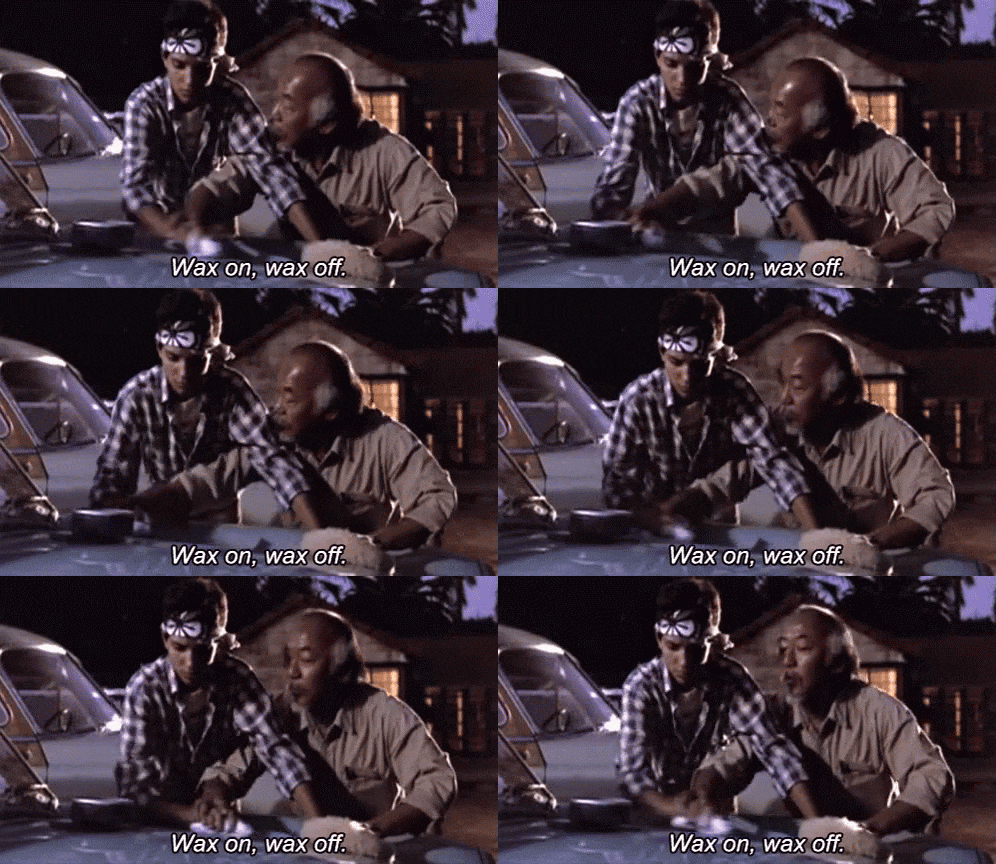

Many people often make the mistake of giving themselves too much to do.
When people decide that reading a book is the habit they want to develop, they decide to read 50 pages every night
Instead, start with 5 or 10.
Someone decides to lose weight as their goal, and chooses that walking every day is their specific habit; they choose to walk half an hour or an hour.
Instead, try starting with a simple 10 or 15-minute walk.
Your first objective isn’t to maximize your output, but rather to establish repetition. This is part of the philosophy of Kaizen.
4Track the Habit as Soon as You Complete It
This is a very simple rule, but very useful.
The second you complete the task, it is important to record it. Don’t rely on tracking and remembering whether or not you did the task at the end of each week. When you complete the task, record it.
This in effect creates a tighter feedback loop, keeps your tracker accurate, and makes things easier for yourself moving forward.
5Review Your Progress, Not Just Your Streak
Every week, you should be asking yourself the following questions:
- How often did I complete this habit?
- When did I struggle?
- What made the habit easier?
- What made it harder?
- Should I change anything next week?
Habit tracking isn’t only a simple form of tracking and collecting checkmarks, but rather a mechanism for feedback, helping you improve and build on your goals. It is important to use the data found in front of you and use it to answer these questions, to learn more about yourself, reaffirm that what you are doing is helping you reach that goal, or where you are going wrong, so that you can get yourself back on the right track.
6Review Your Progress, Not Just Your Streak
There is truly nothing more important than keeping yourself going. No matter how bad it gets, no matter how bad it looks, there is an importance to keep yourself going.
Sometimes it can feel like extra work; logging itself becomes the habit instead of the actual thing you are trying to improve. Missing even one day can make people feel like they have killed the momentum that they have built. It shouldn’t feel like homework, but rather something that is more lightweight and reflective.
People often start by feeling serious for the first few days or weeks; the streak grows, then one bad day happens, and you miss your habit. The end result: the streak breaks. Suddenly, you feel like the whole system is ruined, and it feels pointless. People feel like the chain of tracking and building streaks is like a perfect chain, a straight line, with no room for error. Real discipline is like a wave line: you start off well, it grows, it falls, and it grows again. You fail, adjust, and continue.
People use the logic: “I missed today, I broke the streak, the whole attempt is dead”. They feel the need to restart or turn away from the habit entirely. The truth is, failing is what truly builds you; it is not what defines you.
A broken streak isn’t broken progress.
If you completed the task: Walk 20 minutes every day
Have done so 26 of the last 30 days for the month
That shows excellent consistency regardless of whether your streak is six days or thirty; it is about staying consistent and showing progress.
Consistency over perfection.
Progress over perfection.
How to Build Habits That Stick
It is very simple. You need to stop relying on willpower alone. Build a system within the habit loop that takes a tiny, easy action to an existing daily routine, and make that habit visible- a way to track it. By doing so, you give yourself an immediate reward and a sense of pride.
By starting small, you lead yourself toward the first step that you need to take. The habit should feel so easy and simple that it is hard to fail. Attaching your new habit to something you already do can also help. Focus on consistency and create a mindset where you don’t quit even if you miss multiple days.
An example to follow as an easy, simple habit to track is drinking a glass of water after waking up. You create a trigger by waking up in the morning every day, with the immediate action being drinking the water. By having water next to you before you wake up, you make it easier for you to do. Having a visual cue like leaving a glass of water next to your bed at night or placing a note that you know for sure you will see every day (bathroom mirror) makes the habit easier to stick.
How Long Does It Take for a Habit to Stick
It depends on what you are tracking and the goals you want to reach. The formation of a habit building can range from a few weeks to a couple of months. In the past, research has shown that it can take anywhere from 18 to 254 days for a person to form a new habit. Simple actions like drinking a glass of water in the morning can be done faster, while complex goals such as going to the gym or changing a diet can take over six months potentially.
Habit Tracking for Progress, Not Perfection
The purpose of a habit tracker isn’t supposed to prove that you are perfect. It is supposed to help you answer:
Am I moving in the direction I want to go
One day might not tell you much, but as you progress and take a look back at it and really read into it.
Now you see the meaning, the story behind your results.
You can see your level of consistency, where you went wrong, where you improved, and most importantly, you can see that you are still moving forward, that you never gave up, and that is the most important thing.
One Habit Can Make a Difference
Don’t leave this article and decide to create a list of 10-15 things that you plan to start changing tomorrow.
All you have to do is choose one and make it small and realistic. Define exactly what it would mean to complete it. Track it. Then, continue to show up again the next day. By doing so, you are showing yourself that you can improve, that you are better, that you can do anything you want.
Habits aren’t built by having one perfect day. They are built through the small actions that you repeat often enough that they become a part of your identity and how you live.